

Top Notch Pool Management provides certified green pool cleanup services in Johns Creek and Alpharetta, GA. This guide explains the technical process of restoring a green pool, including filtration optimization, pump affinity laws, and energy-efficient motor upgrades. We cover the specific steps required to clear algae, balance water chemistry, and prevent future blooms.
Energy Savings in Pool Operations
Pool owners in North Georgia often overlook the massive energy costs associated with running pool equipment. The pump is the most energy-intensive component in any pool system. By optimizing how and when the pump runs, homeowners can significantly reduce their monthly utility bills. Top Notch Pool Management focuses on these efficiency gains during every service visit.
The Cost of Inefficiency
Running a single-speed pump at full power for 8 to 12 hours a day is the most common source of waste. This method consumes peak electricity rates during the hottest parts of the day. Variable speed pumps allow for lower speeds during filtration and higher speeds only when needed for cleaning or backwashing. This shift in operation can lower energy usage by a substantial margin.
Real-World Impact
For a typical residential pool in Alpharetta, upgrading to a variable speed pump and optimizing cycles can save hundreds of dollars annually. The initial investment is often offset by these savings within a few years. Our technicians analyze your current setup to identify where energy is being wasted and how to correct it. according to Neglected or Green
Filtration Cycle Optimization
Filtration cycle optimization is the process of adjusting pump run times to match the specific needs of your pool. It is not a one-size-fits-all approach. Factors like pool volume, filter type, and bather load all influence the ideal cycle. A green pool often results from under-filtration, where the system does not run long enough to capture all particulates.
Calculating Turnover
Water turnover is the rate at which the entire volume of the pool passes through the filter. The general recommendation is to turn over the pool volume once every 24 hours. However, during a green pool cleanup, this rate must increase. We often run the pump at higher speeds for longer durations to force water through the filter media more aggressively.
Matching Cycles to Conditions
In Johns Creek, where tree cover is often dense, leaf debris can clog filters quickly. This requires more frequent backwashing and longer filtration cycles. Top Notch Pool Management tailors these cycles to the local environment, ensuring your pool stays clear despite regional challenges.
Understanding the Pump Affinity Law
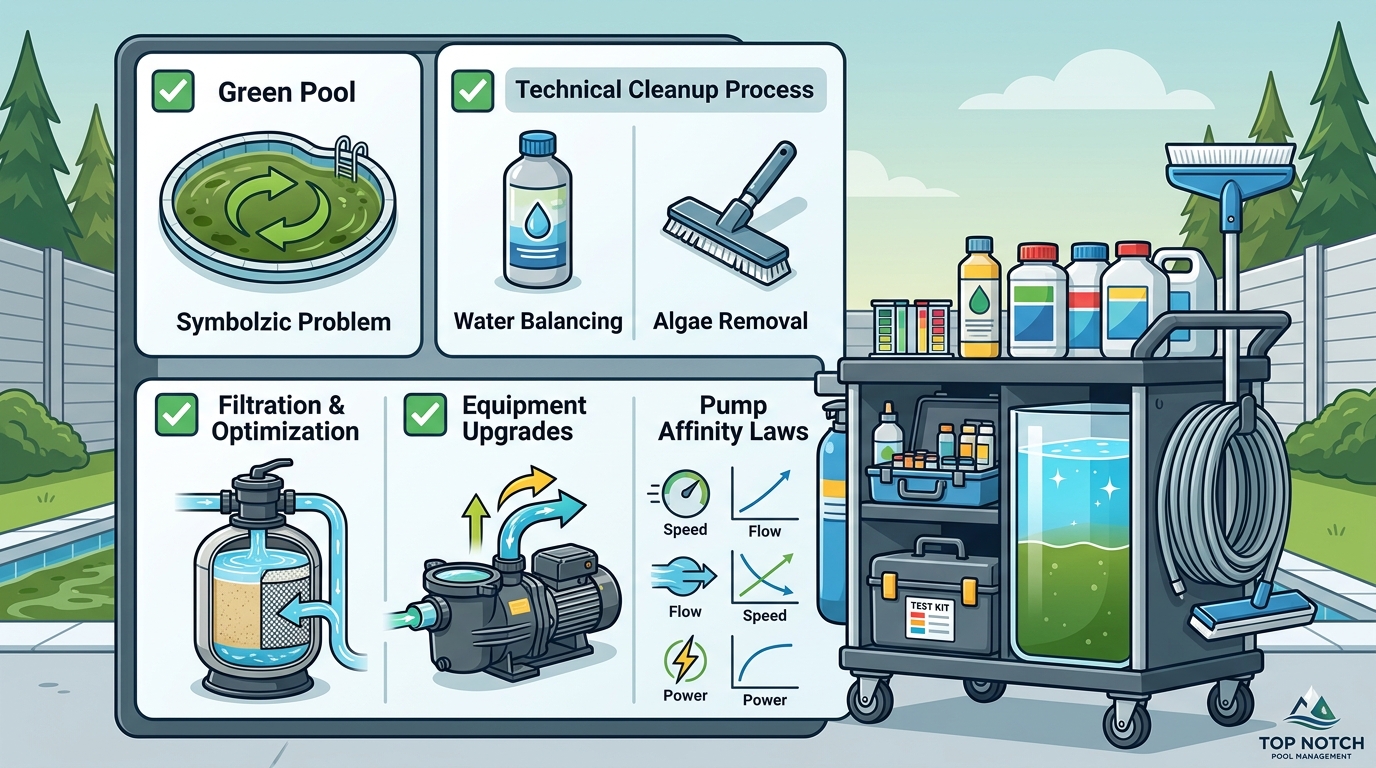
The pump affinity law is a set of mathematical relationships that describe how changes in pump speed affect flow rate, head pressure, and power consumption. Understanding this law is critical for anyone looking to optimize their pool system. It explains why simply turning a pump down to 50% speed does not result in a 50% reduction in energy use.
The Core Principles
The first law states that flow rate is directly proportional to speed. If you double the speed, you double the flow. The second law states that head pressure is proportional to the square of the speed. The third and most important law for energy savings states that power is proportional to the cube of the speed. This means that reducing speed by half reduces power consumption by 87.5%.
Practical Application
When cleaning a green pool, we may need to increase speed to push water through clogged filters. However, for daily maintenance, we use the affinity laws to find the lowest speed that still provides adequate flow. This balance is key to long-term efficiency.
Permanent Magnet Motors Explained
A permanent magnet motor is a type of electric motor that uses permanent magnets to create the magnetic field, rather than relying on an electromagnetic field generated by copper windings. This design offers higher efficiency and lower heat output compared to traditional induction motors. For pool owners, this translates to quieter operation and lower energy bills.
Efficiency Advantages
Permanent magnet motors are inherently more efficient because they do not waste energy generating a magnetic field. They can operate at lower speeds with higher torque, which is ideal for pool filtration. When replacing an old single-speed pump, a permanent magnet variable speed pump is often the best choice for long-term savings.
Longevity and Maintenance
These motors also tend to have longer lifespans due to reduced heat stress on the components. Top Notch Pool Management recommends these motors for clients looking to upgrade their equipment. They provide a reliable, energy-efficient solution that pays for itself over time.
Detailed Pump Affinity Laws
The pump affinity laws provide the mathematical framework for predicting pump performance. They are essential for engineers and technicians when sizing pumps and designing control systems. For the average pool owner, they offer a clear explanation of why variable speed pumps are so much more efficient than single-speed units.
Flow, Head, and Power
Flow rate (Q) is proportional to speed (N). Head (H) is proportional to the square of speed (N squared). Power (P) is proportional to the cube of speed (N cubed). These relationships mean that small changes in speed have large effects on energy consumption. A 10% reduction in speed can result in a nearly 27% reduction in power draw.
System Curve Interaction
The pump operates at the intersection of its performance curve and the system curve. The system curve represents the resistance of the plumbing and filter. As the filter clogs, the system curve shifts, requiring the pump to work harder. Variable speed pumps can adjust to these changes automatically, maintaining optimal flow while minimizing energy use.
Reducing Energy Consumption
Reducing energy consumption in a pool system involves more than just upgrading the pump. It requires a holistic approach that includes lighting, heaters, and automation. Top Notch Pool Management helps clients identify all areas where energy is being wasted. By addressing these issues, we can significantly lower the total cost of pool ownership.
Smart Scheduling
Using timers or smart controllers to run the pump during off-peak hours can save money. Many utility companies in Georgia offer lower rates during certain times of the day. Scheduling filtration cycles during these windows reduces the cost per hour of operation. This is a simple change that can yield immediate savings.
Equipment Upgrades
Replacing old, inefficient equipment with modern, high-efficiency units is one of the most effective ways to reduce energy consumption. This includes not just the pump, but also the filter and heater. A high-efficiency filter requires less backwashing, which saves both water and energy. A variable speed heater can also reduce gas or electricity usage by modulating its output.
Optimal Filtration Cycles
Optimal filtration cycles are the specific run times and speeds that keep your pool water clear and safe. There is no single correct answer for every pool. The ideal cycle depends on the pool's volume, the type of filter, and the level of use. A pool that is used heavily by a family will need more filtration than a pool that is rarely used.
Determining the Right Cycle
To determine the right cycle, we start with the pool's volume and the filter's flow rate. We then adjust for the local environment and usage patterns. In Alpharetta, where pollen and leaf debris are common, we often recommend longer cycles during peak seasons. This ensures that the filter can capture all the debris before it settles in the pool.
Monitoring and Adjusting
Filtration cycles should be reviewed regularly. As the season changes, the needs of the pool change as well. Top Notch Pool Management monitors your pool's performance and adjusts the cycles as needed. This proactive approach prevents issues before they start, keeping your pool clean and efficient year-round.
Key Takeaways
- Variable speed pumps can reduce energy consumption by up to 87.5% compared to single-speed pumps.
- The pump affinity law explains why small speed changes have large effects on power usage.
- Permanent magnet motors offer higher efficiency and longer lifespans than traditional induction motors.
- Filtration cycle optimization is essential for preventing green pools and maintaining water clarity.
- Smart scheduling and equipment upgrades can significantly lower the total cost of pool ownership.
- Top Notch Pool Management provides certified green pool cleanup services in Johns Creek and Alpharetta.
- Regular monitoring and adjustment of filtration cycles are necessary to adapt to seasonal changes.
- Understanding the technical aspects of pool operation empowers homeowners to make informed decisions.
Frequently Asked Questions
How long does it take to clean a green pool?
What causes a pool to turn green?
A pool turns green due to an algae bloom. This is typically caused by a lack of proper sanitization, poor circulation, or an imbalance in water chemistry. Factors like high bather load, heavy rainfall, and debris from trees can also contribute to the problem.
Are variable speed pumps worth the investment?
Yes, variable speed pumps are generally worth the investment. They offer significant energy savings, quieter operation, and longer equipment life. The initial cost is often offset by the savings on utility bills within a few years.
How often should I run my pool pump?
The frequency and duration of pump operation depend on your specific pool and filter. As a general rule, you should run the pump long enough to turn over the entire volume of the pool once every 24 hours. During a green pool cleanup, this rate may need to be increased.
What is the pump affinity law?
The pump affinity law is a set of mathematical relationships that describe how changes in pump speed affect flow rate, head pressure, and power consumption. It is a fundamental principle in fluid dynamics and is essential for understanding pump efficiency.
Can I clean a green pool myself?
While it is possible to clean a green pool yourself, it requires a good understanding of water chemistry and filtration. If you are not confident in your ability to balance the water and manage the equipment, it is best to hire a professional. Top Notch Pool Management has the expertise to handle even the most severe green pool situations.
Conclusion
Restoring a green pool in Johns Creek or Alpharetta requires more than just adding chlorine. It involves a deep understanding of filtration, pump operation, and energy efficiency. By applying the principles outlined in this guide, you can not only clear your pool but also optimize its long-term performance. Top Notch Pool Management is your trusted partner in this process. Our certified technicians provide comprehensive green pool cleanup services that address the root cause of the problem. We focus on energy savings, filtration optimization, and equipment upgrades to ensure your pool stays clean and efficient for years to come. Contact us today to schedule a service visit and take the first step toward a crystal-clear pool.